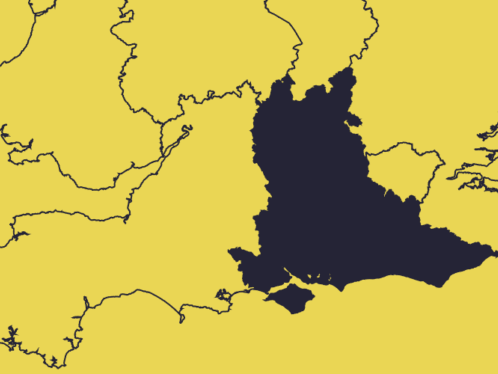



In this article, we break down the latest South East UK cyber crime statistics, analysing where reports are coming from, which scams are most common, and where the biggest financial losses are occurring. The data reveals a clear pattern:
While some fraud types generate the highest number of incidents, others, particularly investment scams, are responsible for the most significant financial damage.
Understanding these trends is the first step to protecting yourself and your organisation.
So let’s take a closer look at what the South East UK cyber crime statistics are really telling us.
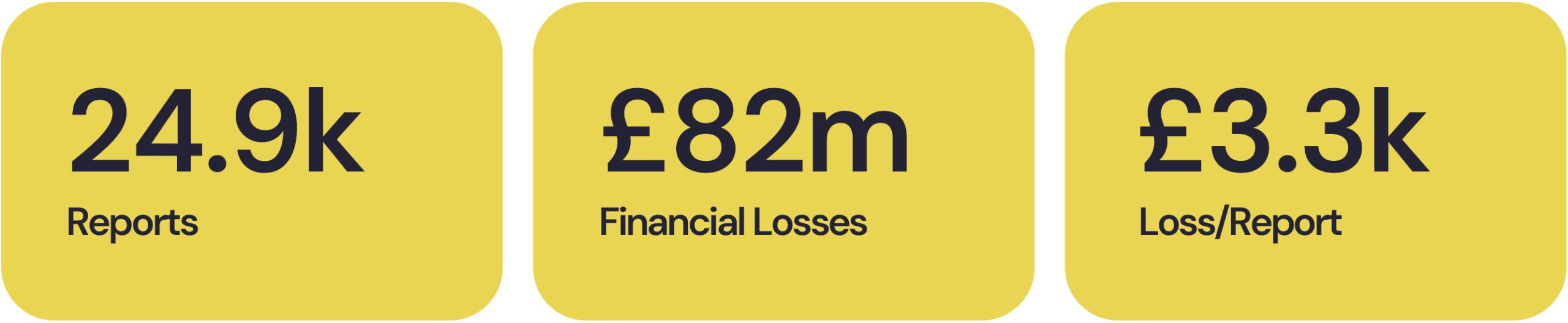
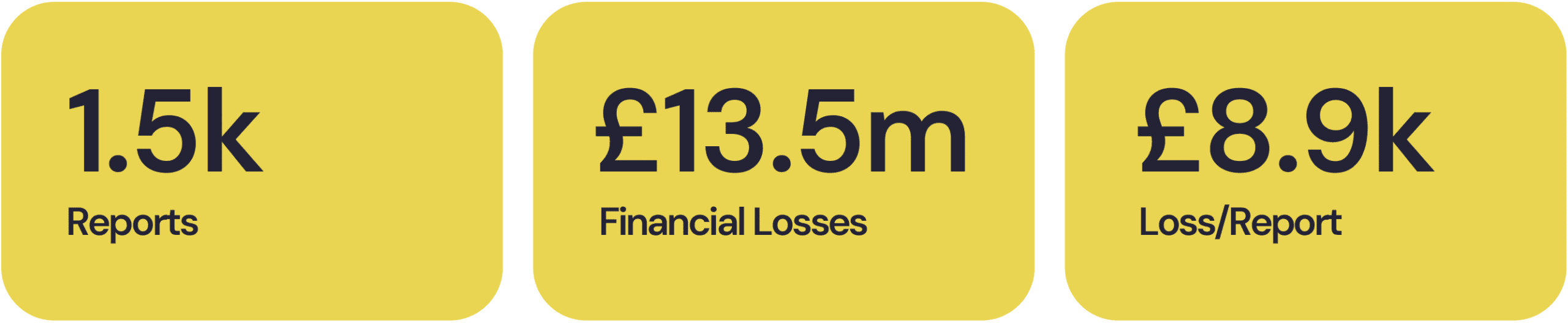
In the 12 months leading up to 1 January 2026 in the South East of the UK, there have been:
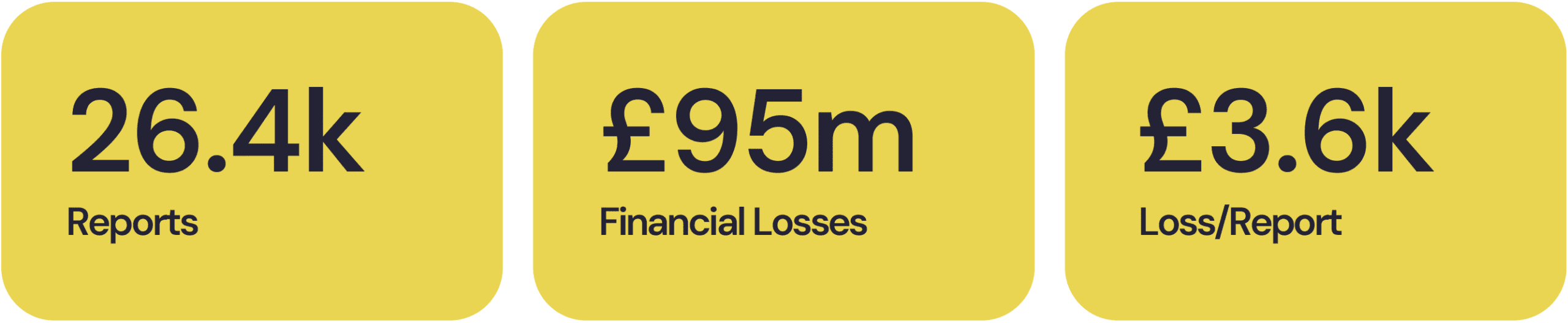 Source: Report Fraud (Formerly Action Fraud)
South East UK Cyber Crime Key Insights
- Consumer fraud drives the highest number of cyber crime reports – Consumer scams account for 37.6% of incidents (9.9k reports), reflecting the scale of fraud linked to online shopping, ticket sales, and marketplace platforms.
- Cyber-enabled crime represents a major share of activity – Cyber dependent offences account for 26.7% of reports (7.1k incidents), highlighting the growing role of hacking, malware, and online account compromise.
- Investment fraud generates the largest financial losses – Despite representing only 7.6% of reports, investment scams account for 46.2% of total losses (£43.9m), demonstrating how fewer but high-value scams drive financial damage.
- Consumer scams combine high volume with significant financial impact – Consumer fraud accounts for 28.5% of financial losses (£27.1m), making it both the most common and one of the most costly crime types.
- Banking fraud remains a major financial threat – Banking-related scams account for £13.7m in losses (14.4%), with an average loss of £5.2k per incident.
Individuals
- Consumer scams dominate cyber crime affecting individuals – Individuals report 37.9% of incidents (9.4k reports) in the consumer category, driven largely by online shopping, ticket, and marketplace fraud.
- Public sector incidents carry the highest financial loss per report – Although representing just 0.6% of losses (£459.4k) and only 6 reports, the average loss reaches £76.6k per incident, the highest of any crime category.
- Investment scams cause the greatest financial damage to individuals – These scams account for 51.3% of total losses (£41.8m), with an average loss of £21.1k per report.
- Older age groups experience the largest financial losses – Individuals aged 60–69 account for £17.5m (21.5%) of losses, followed closely by 40–49 year olds with £16.6m (20.4%).
- People aged 30–39 report the highest number of cyber crime incidents – This group accounts for 21.3% of reports (5.3k incidents), the highest of any age bracket.
Organisations
- Banking fraud is the most common cyber crime affecting organisations – Banking-related scams account for 46.4% of business reports (705 incidents), highlighting the risk of payment diversion and financial compromise.
- Limited companies experience the vast majority of business cyber crime – Limited businesses account for 78.2% of incidents (1.1k reports) and 81.5% of financial losses (£11m).
- Investment scams result in the highest losses per incident for organisations – Although representing 15.6% of losses (£2.1m), they generate the highest average loss of £65.6k per report.
- Consumer fraud remains a significant threat to businesses – Consumer-related scams account for 33.3% of business reports (506 incidents) and £4.5m in losses.
- Corporate incidents carry substantial financial impact despite low volume – Corporate-related fraud accounts for only 2.2% of reports, but results in £561k in losses with an average of £17k per incident.
South East UK Cyber Crime Statistics Breakdown
Crime Types
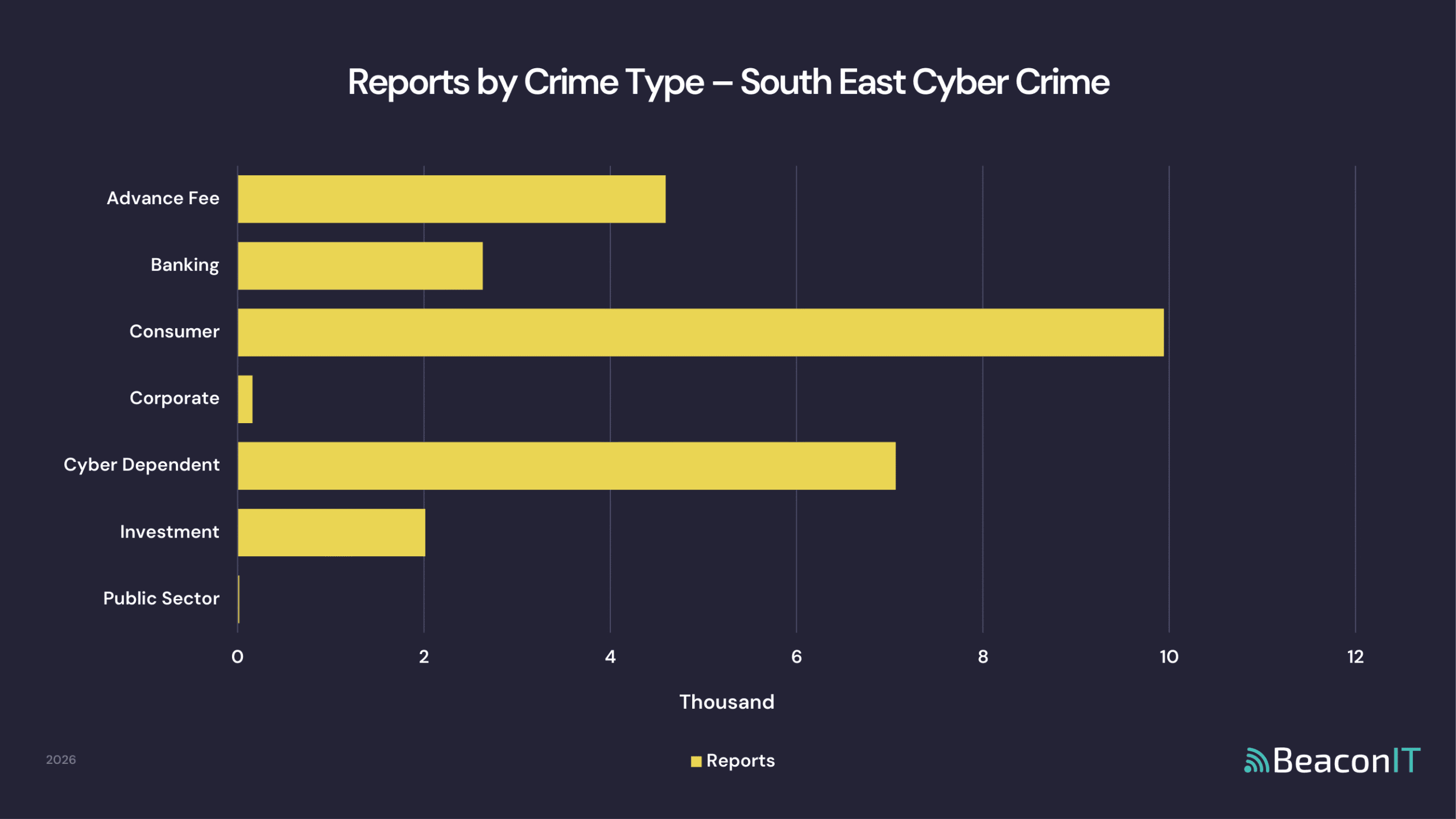
By report volume
| Crime Type | Reports | % |
| Advance Fee | 4.6k | 17.4% |
| Banking | 2.6k | 10.0% |
| Consumer | 9.9k | 37.6% |
| Corporate | 160 | 0.6% |
| Cyber Dependent | 7.1k | 26.7% |
| Investment | 2.0k | 7.6% |
| Public Sector | 17 | 0.1% |
Insights for Report Volume
- Consumer fraud dominates reports – Consumer scams account for 37.6% of incidents, driven largely by online shopping, ticketing, and marketplace fraud.
- Cyber-dependent crime is the second largest category – Hacking, malware, and credential theft make up 26.7% of all reports, highlighting a significant technical threat alongside fraud.
- Financial fraud drives the majority of cyber crime – Consumer, advance fee, banking, and investment scams combined represent over 70% of reported incidents in the region.
- Advance fee scams remain widespread – Despite being one of the oldest fraud models, 17.4% of incidents still involve advance fee schemes.
- Business cyber crime appears heavily underreported – Corporate incidents represent just 0.6% of reports, suggesting many business attacks may be handled privately rather than formally reported.
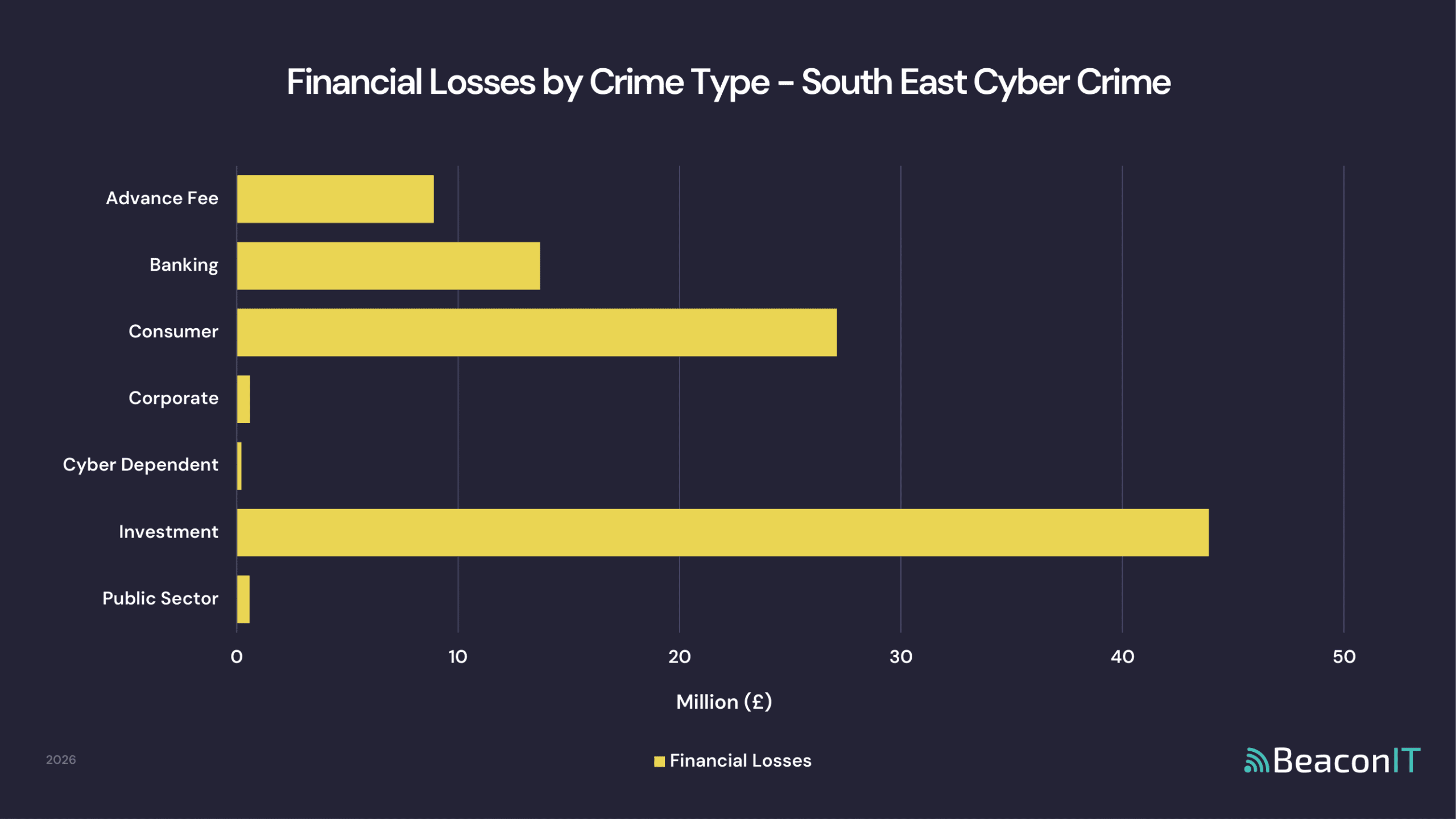
By financial losses
| Crime Type | Losses | % | Loss/Report |
| Advance Fee | £8.9m | 9.4% | £1.9k |
| Banking | £13.7m | 14.4% | £5.2k |
| Consumer | £27.1m | 28.5% | £2.7k |
| Corporate | £0.6m | 0.6% | £3.8k |
| Cyber Dependent | £215.9k | 0.2% | £31 |
| Investment | £43.9m | 46.2% | £21.8k |
| Public Sector | £588k | 0.6% | £34.6k |
Insights for Financial Losses
- Investment fraud drives the majority of financial losses – Investment scams account for 46.2% of all losses (£43.9m) despite representing only 7.6% of reports, highlighting the extreme financial impact of these schemes.
- Consumer fraud generates the highest overall losses after investment scams – Consumer-related incidents account for £27.1m in losses (28.5%), reflecting the high volume of scams linked to online shopping, ticketing, and digital marketplaces.
- Banking fraud produces significant financial impact per incident – Banking-related scams account for £13.7m in losses (14.4%), with an average loss of £5.2k per report, indicating that compromised accounts can quickly lead to substantial financial damage.
- Cyber-dependent crime causes minimal direct financial loss – Despite representing 26.7% of reports, cyber-dependent incidents account for just 0.2% of total losses, with an average loss of £31 per report.
- Public sector incidents are rare but extremely costly when they occur – While representing just 0.6% of losses, public sector incidents show the highest average loss per report (£34.6k), suggesting that attacks on institutions can carry substantial financial consequences.
South East UK Cyber Crime Statistics for Individuals
Crime Types
By report volume
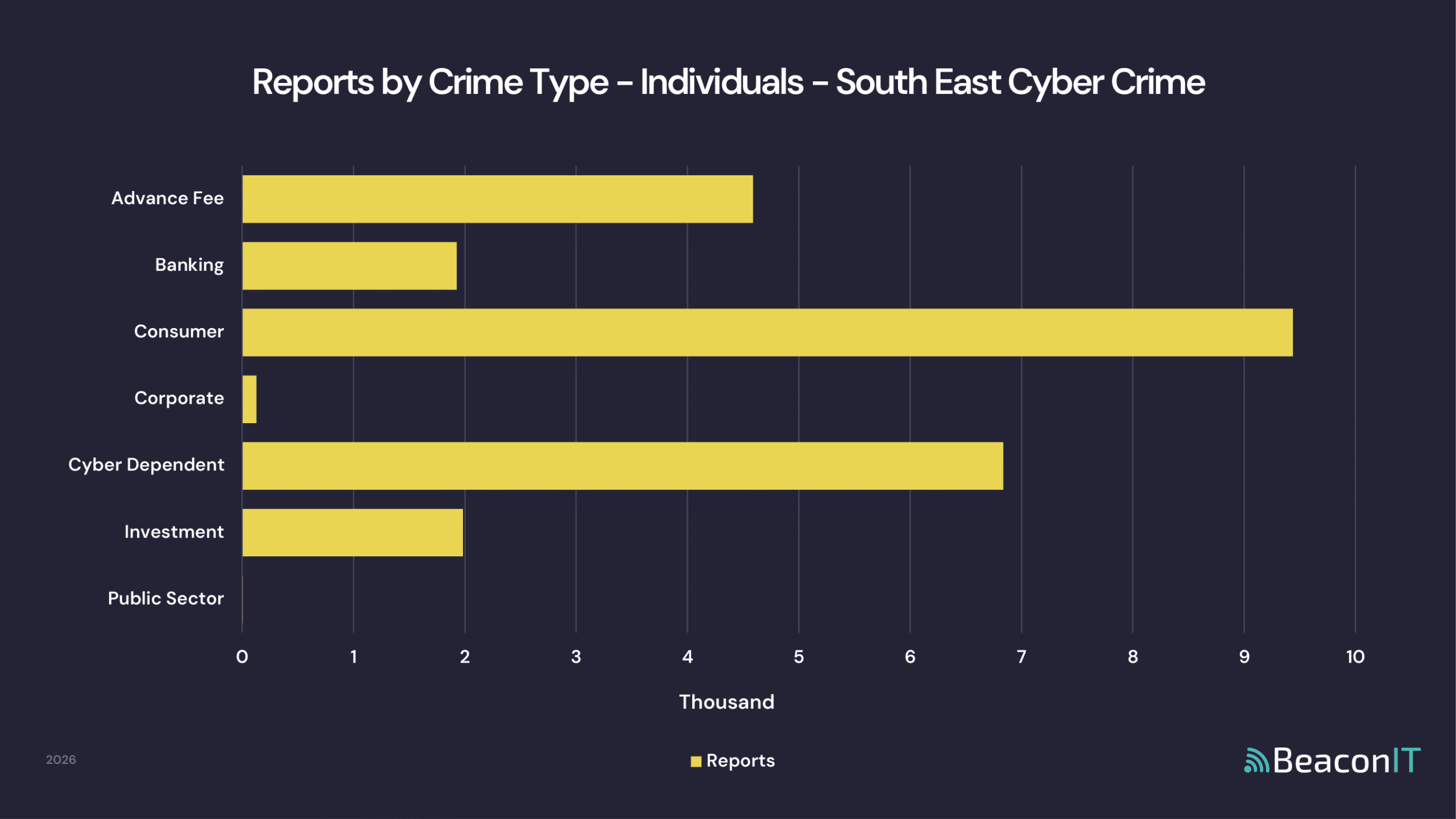
| Crime Type | Reports | % |
| Advance Fee | 4.6k | 18.4% |
| Banking | 1.9k | 7.7% |
| Consumer | 9.4k | 37.9% |
| Corporate | 127 | 0.5% |
| Cyber Dependent | 6.8k | 27.4% |
| Investment | 2.0k | 8.0% |
| Public Sector | 6 | 0.0% |
Insights for Individual Report Volume
- Consumer scams dominate cyber crime affecting individuals – Consumer fraud accounts for 37.9% of all reports (9.4k incidents), largely linked to online shopping, ticketing, and marketplace scams.
- Technical cyber attacks remain a major threat to individuals – Cyber-dependent offences such as hacking, malware, and account compromise represent 27.4% of incidents (6.8k reports).
- Advance fee scams continue to affect thousands of victims – Advance fee fraud accounts for 18.4% of reports (4.6k incidents), showing the persistence of scams involving loans, investments, or fake opportunities requiring upfront payments.
- Banking and investment fraud remain significant risks – Combined, banking and investment scams account for 15.7% of reports (3.9k incidents), often involving compromised accounts or fraudulent financial schemes.
- Corporate and public sector incidents are extremely rare in individual reporting – These categories account for less than 1% of reports, highlighting that the vast majority of cyber crime in this dataset affects private individuals rather than organisations.
By financial losses
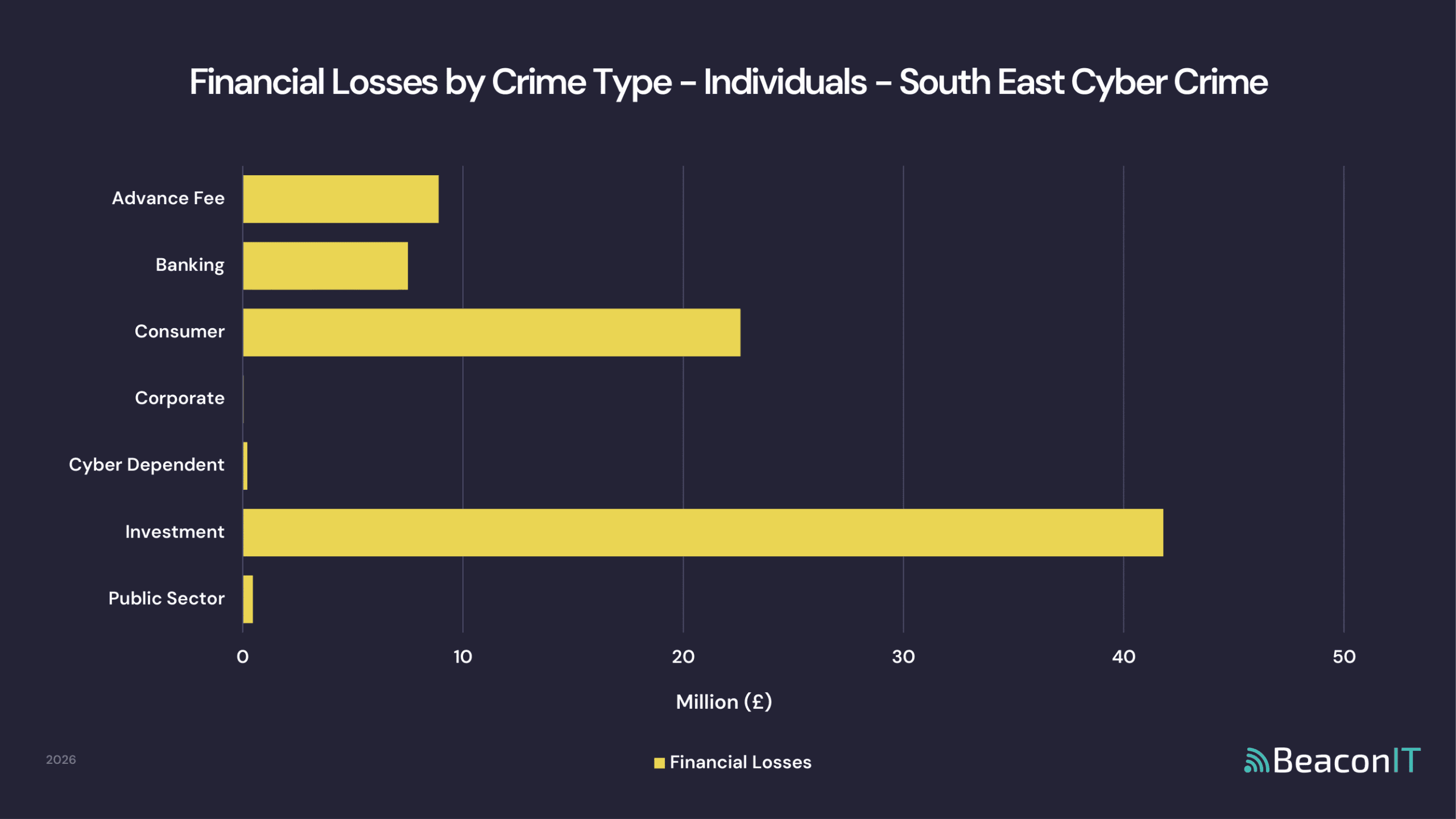
| Crime Type | Losses | % | Loss/Report |
| Advance Fee | £8.9m | 10.9% | £1.9k |
| Banking | £7.5m | 9.2% | £3.9k |
| Consumer | £22.6m | 27.7% | £2.4k |
| Corporate | £44.6k | 0.1% | £351 |
| Cyber Dependent | £205.5k | 0.3% | £30 |
| Investment | £41.8m | 51.3% | £21.1k |
| Public Sector | £459.4k | 0.6% | £76.6k |
Insights for Individual Financial Losses
- Investment scams cause the majority of financial losses for individuals – Investment fraud accounts for 51.3% of total losses (£41.8m) despite representing only 8% of reported incidents, demonstrating the severe financial impact of these schemes.
- Consumer scams generate the second-highest financial losses – Consumer fraud accounts for £22.6m in losses (27.7%), reflecting the high volume of scams linked to online shopping, ticketing, and digital marketplaces.
- Advance fee scams continue to cause significant financial harm – Advance fee fraud accounts for £8.9m in losses (10.9%), despite relatively modest average losses of £1.9k per report.
- Banking fraud results in substantial losses per victim – Banking-related scams account for £7.5m in losses (9.2%), with an average loss of £3.9k per incident.
- Public sector incidents carry the highest financial loss per report – Although representing just 0.6% of losses (£459.4k) and only six reported incidents, the average loss reaches £76.6k per report, the highest of any category.
Age Demographics
By report volume
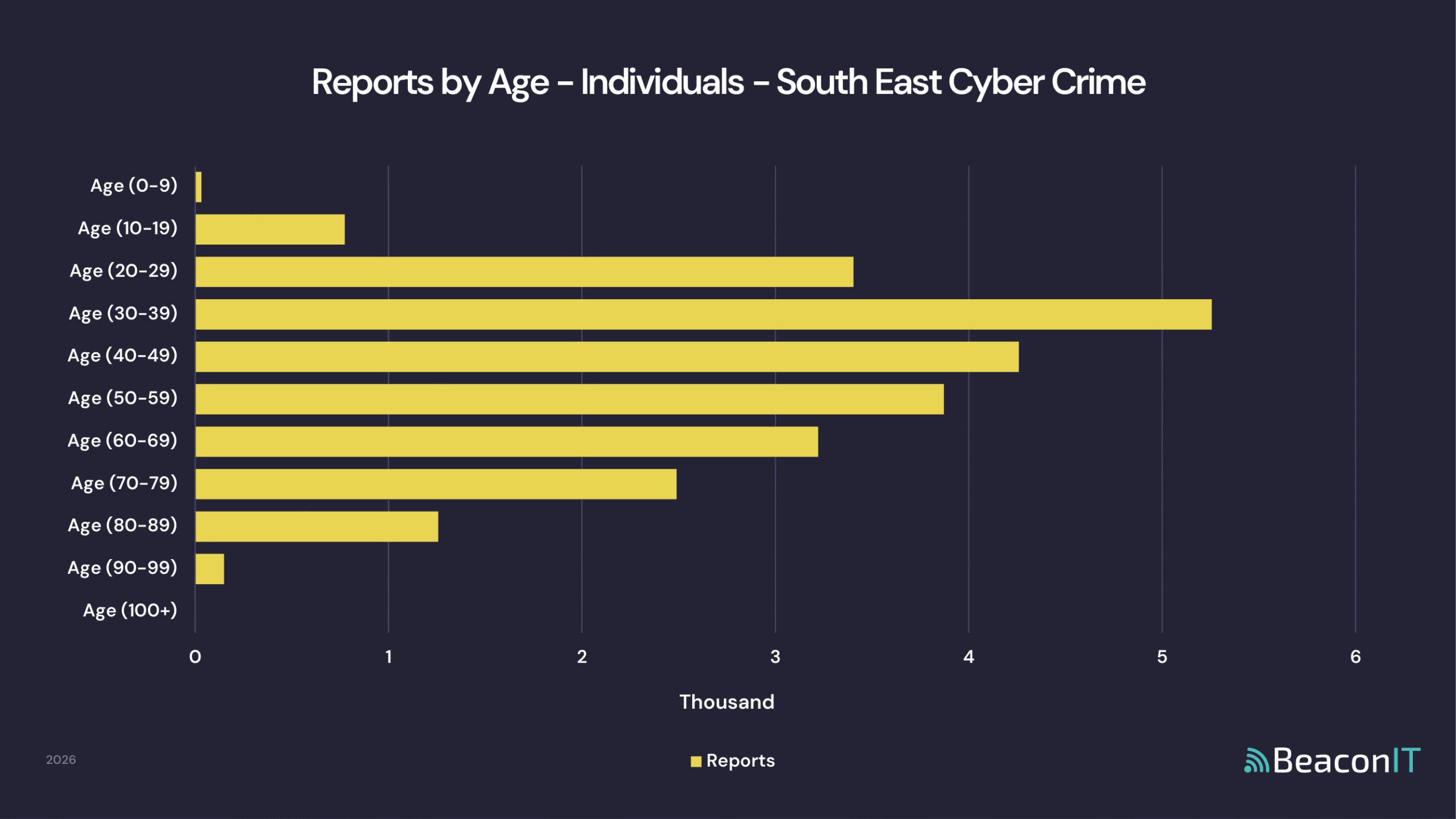
| Age | Reports | % |
| Age (0-9) | 32 | 0.1% |
| Age (10-19) | 774 | 3.1% |
| Age (20-29) | 3.4k | 13.8% |
| Age (30-39) | 5.3k | 21.3% |
| Age (40-49) | 4.3k | 17.2% |
| Age (50-59) | 3.9k | 15.7% |
| Age (60-69) | 3.2k | 13.0% |
| Age (70-79) | 2.5k | 10.1% |
| Age (80-89) | 1.3k | 5.1% |
| Age (90-99) | 149 | 0.6% |
| Age (100+) | 2 | 0.0% |
Insights for Report Volume via Age Demographics
- People aged 30–39 report the highest number of cyber crime incidents – This group accounts for 21.3% of all reports (5.3k incidents), making them the most frequently affected age group.
- Cyber crime heavily impacts working-age adults – Individuals aged 20–49 account for over 52% of all reports, reflecting the high level of online activity in these age groups.
- Middle-aged individuals remain a key target for scams – People aged 40–59 represent 32.9% of incidents (8.2k reports), suggesting criminals frequently target individuals with established financial activity.
- Reports decline steadily among older age groups – While those aged 60–79 still account for 23.1% of incidents, reporting drops significantly beyond this range.
- Very young and very old age groups account for minimal incidents – Individuals under 20 years old represent just 3.2% of reports, while those aged 90+ account for less than 1%.
By financial losses
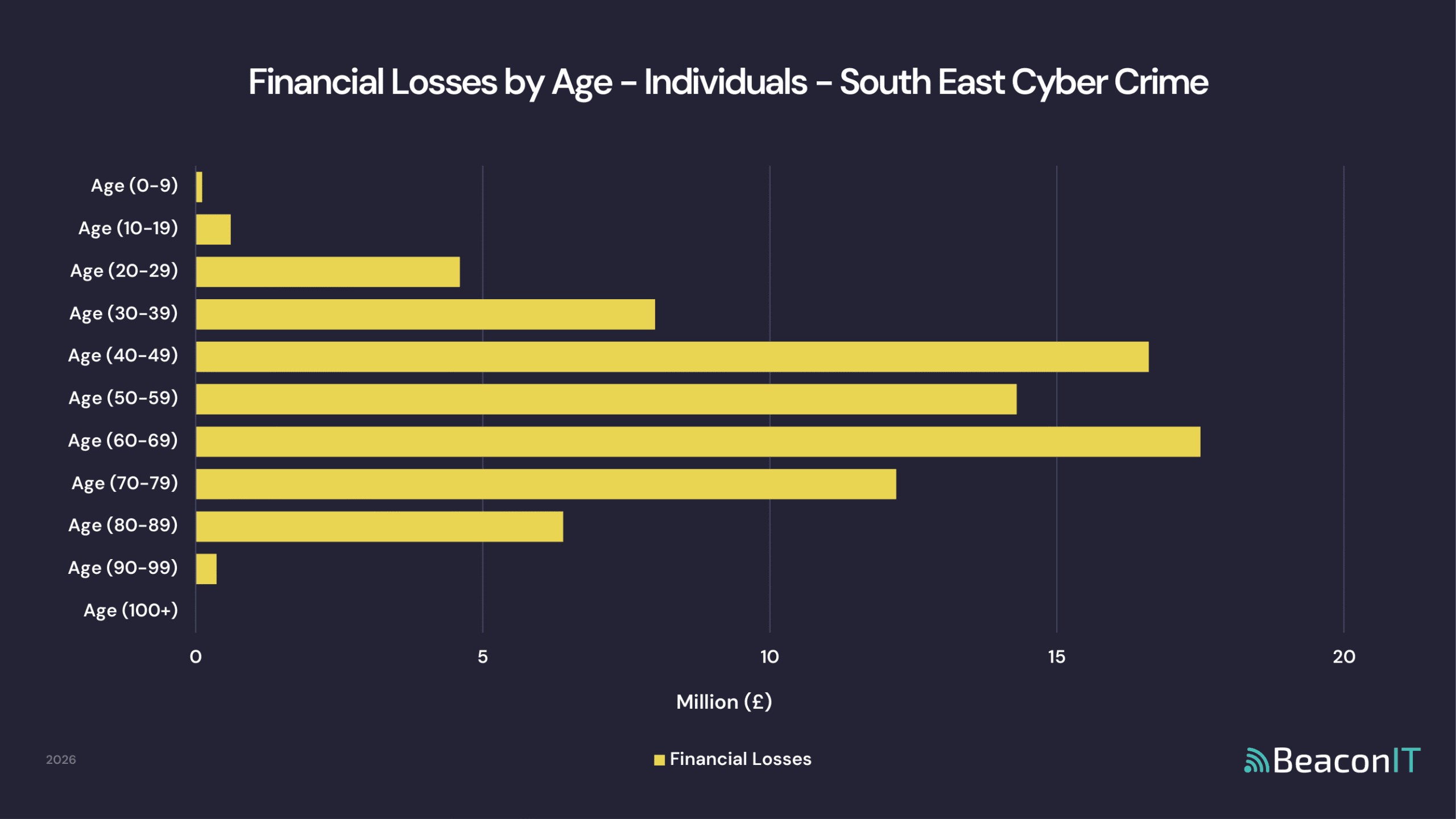
| Age | Losses | % | Loss/Report |
| Age (0-9) | £113k | 0.1% | £3.5k |
| Age (10-19) | £610.5k | 0.7% | £789 |
| Age (20-29) | £4.6m | 5.6% | £1.4k |
| Age (30-39) | £8m | 9.8% | £1.5k |
| Age (40-49) | £16.6m | 20.4% | £3.9k |
| Age (50-59) | £14.3m | 17.5% | £3.7k |
| Age (60-69) | £17.5m | 21.5% | £5.4k |
| Age (70-79) | £12.2m | 15% | £4.9k |
| Age (80-89) | £6.4m | 7.9% | £5.1k |
| Age (90-99) | £363.6k | 0.4% | £2.4k |
| Age (100+) | £4.3k | 0.0% | £2.2k |
Insights for Financial Losses via Age Demographics
- People aged 60–69 suffer the highest financial losses – This group accounts for 21.5% of total losses (£17.5m), with the highest average loss per report (£5.4k).
- Middle-aged adults experience the largest overall financial impact – Individuals aged 40–59 account for 37.9% of losses (£30.9m), reflecting high online financial activity in these age groups.
- Financial losses increase significantly with age – The average loss per incident rises steadily from £1.4k for ages 20–29 to over £5k for people aged 60–79, suggesting criminals often extract larger sums from older victims.
- Younger victims experience lower financial impact – Individuals aged 20–39 account for over 35% of reports but only 15.4% of losses, indicating smaller financial exposure per incident.
- Older age groups remain vulnerable to high-value scams – People aged 70–89 account for 22.9% of total losses (£18.6m), despite representing a smaller share of overall reports.
South East UK Cyber Crime Statistics for Organisations
Crime Types
By report volume
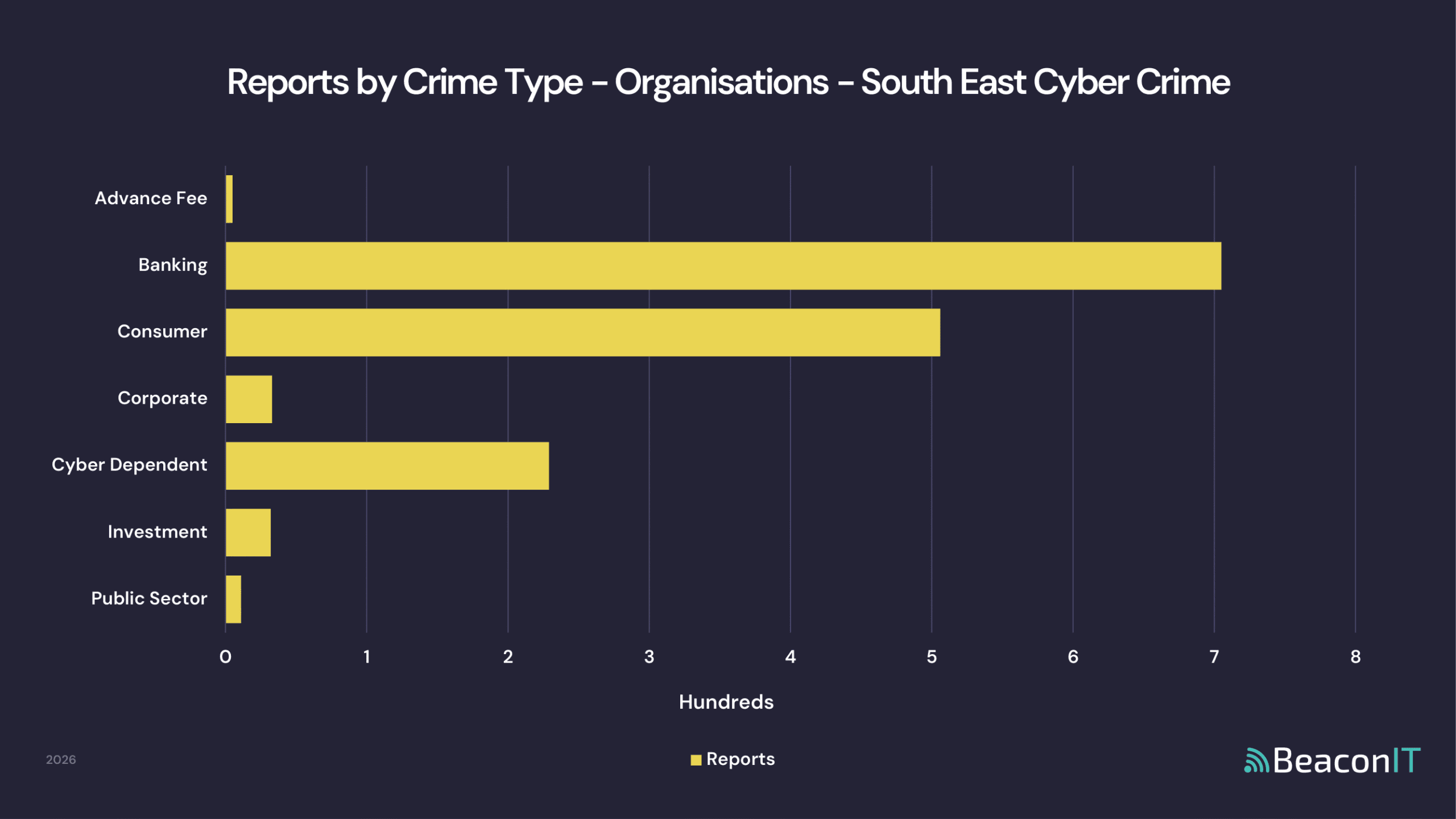
| Crime Type | Reports | % |
| Advance Fee | 5 | 0.3% |
| Banking | 705 | 46.4% |
| Consumer | 506 | 33.3% |
| Corporate | 33 | 2.2% |
| Cyber Dependent | 229 | 15.1% |
| Investment | 32 | 2.1% |
| Public Sector | 11 | 0.7% |
Insights for Organisational Report Volume
- Banking fraud is the most common cyber crime affecting organisations – Banking-related incidents account for 46.4% of reports (705 incidents), often involving compromised accounts or fraudulent payment requests.
- Consumer-related scams also heavily impact organisations – Consumer fraud represents 33.3% of incidents (506 reports), frequently linked to online transactions, marketplace activity, and digital payment fraud.
- Technical cyber attacks remain a significant organisational threat – Cyber-dependent incidents such as hacking, malware, and account compromise account for 15.1% of reports (229 incidents).
- Corporate and investment fraud incidents are relatively rare – These categories account for just 4.3% of reports combined, suggesting they occur less frequently but may still carry significant financial impact.
- Advance fee and public sector incidents represent a very small share of reports – Together they account for just 1% of incidents, making them the least common cyber crime categories affecting organisations.
By financial losses
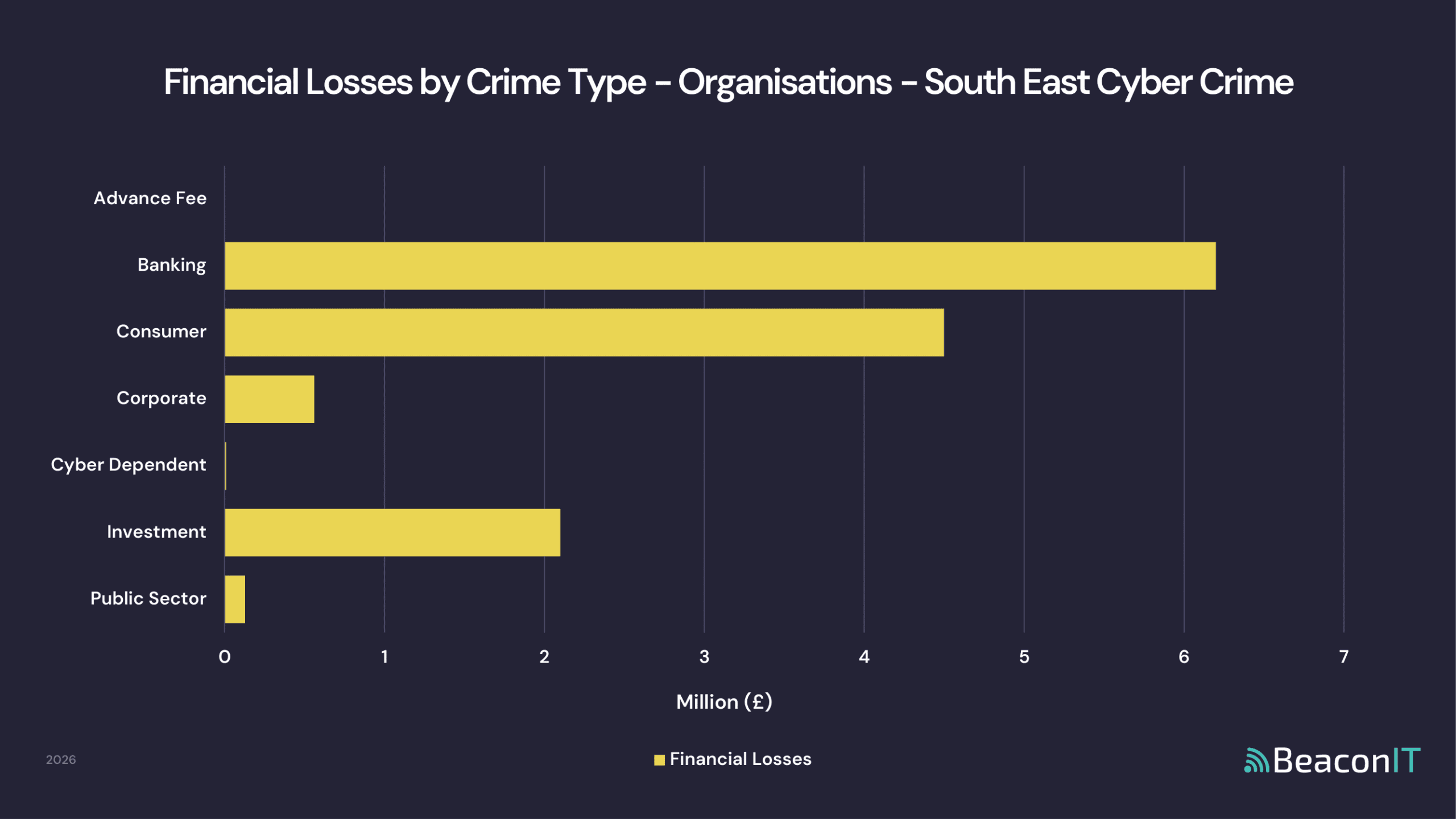
| Crime Type | Losses | % | Loss/Report |
| Advance Fee | £2.4k | 0.0% | £480 |
| Banking | £6.2m | 45.9% | £8.8k |
| Consumer | £4.5m | 33.3% | £8.9k |
| Corporate | £561.4k | 4.2% | £17k |
| Cyber Dependent | £10.4k | 0.1% | £45 |
| Investment | £2.1m | 15.6% | £65.6k |
| Public Sector | £128.6k | 1.0% | £11.7k |
Insights for Organisational Financial Losses
- Banking fraud causes the largest financial losses for organisations – Banking-related incidents account for 45.9% of total losses (£6.2m), with an average loss of £8.8k per report.
- Consumer scams generate a significant share of organisational losses – Consumer-related fraud accounts for £4.5m in losses (33.3%), reflecting the high volume of scams linked to online transactions and digital payments.
- Investment fraud results in the highest loss per incident – Although representing 15.6% of losses (£2.1m), investment scams show an average loss of £65.6k per report, the highest of any category.
- Corporate cyber incidents carry substantial financial impact – Corporate-related incidents account for £561.4k in losses, with a high average loss of £17k per report.
- Cyber-dependent attacks rarely lead to direct financial loss – Despite being a recognised threat, these incidents account for just 0.1% of losses, with an average loss of £45 per report.
Business Types
By report volume
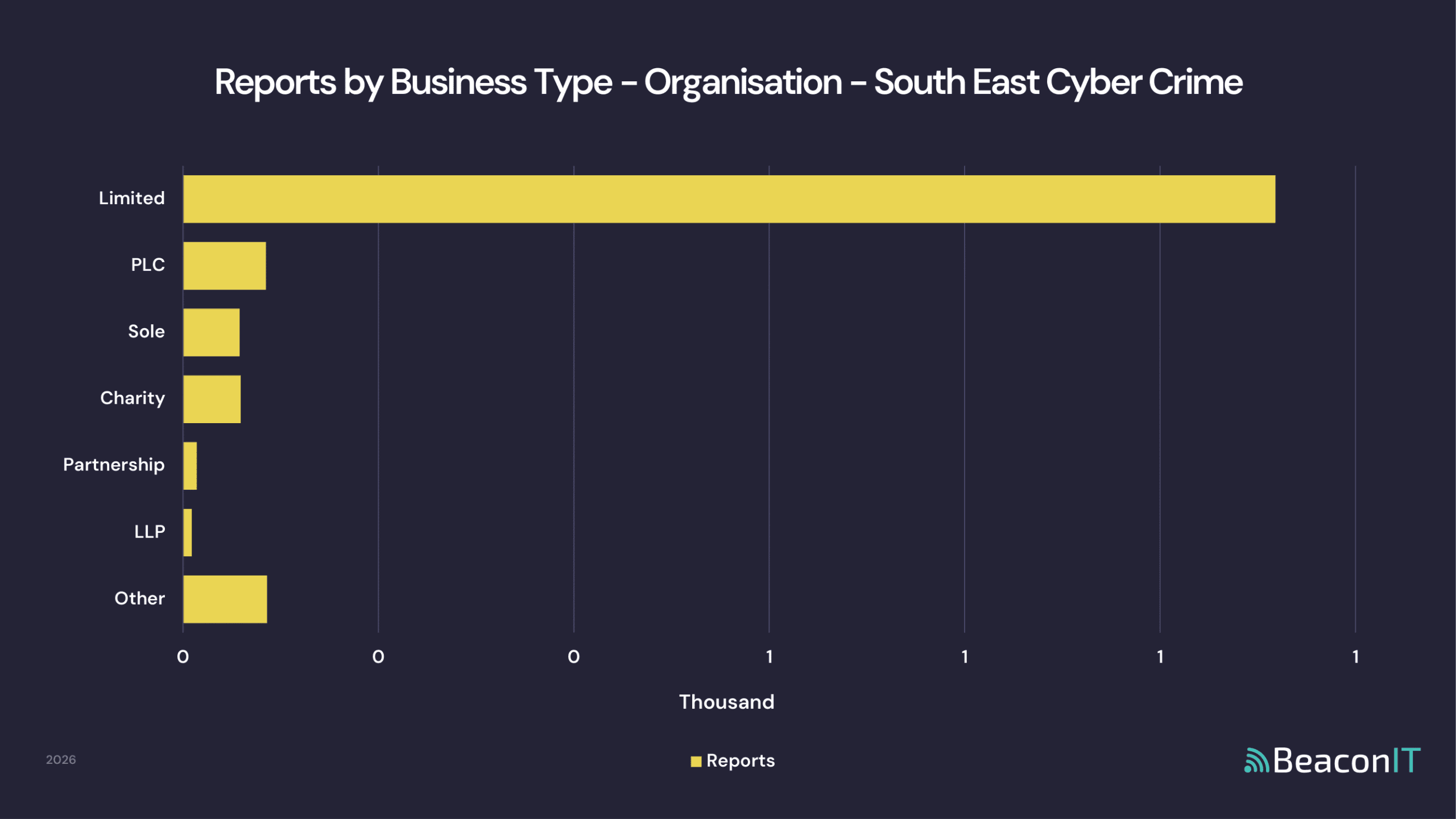
| Business Type | Reports | % |
| Limited | 1.1k | 78.2% |
| PLC | 85 | 5.9% |
| Sole | 58 | 4.1% |
| Charity | 59 | 4.1% |
| Partnership | 14 | 1.0% |
| LLP | 9 | 0.6% |
| Other | 86 | 6.0% |
Insights for Organisational Report Volume via Business Types
- Limited companies account for the vast majority of cyber crime reports – Limited businesses represent 78.2% of incidents (1.1k reports), reflecting their dominant share of the regional business landscape.
- Publicly listed companies report relatively few incidents – PLCs account for 5.9% of reports (85 incidents) despite typically having larger operational footprints.
- Small businesses remain exposed to cyber crime – Sole traders and partnerships account for 5.1% of incidents combined, demonstrating that smaller organisations are still targeted.
- Charities experience a similar level of cyber incidents as sole traders – Charitable organisations account for 4.1% of reports (59 incidents), highlighting their vulnerability to financial and phishing scams.
- Other and LLP business structures represent a small share of incidents – Together they account for 6.6% of reports, indicating cyber crime affects organisations across a wide range of legal structures.
By financial losses
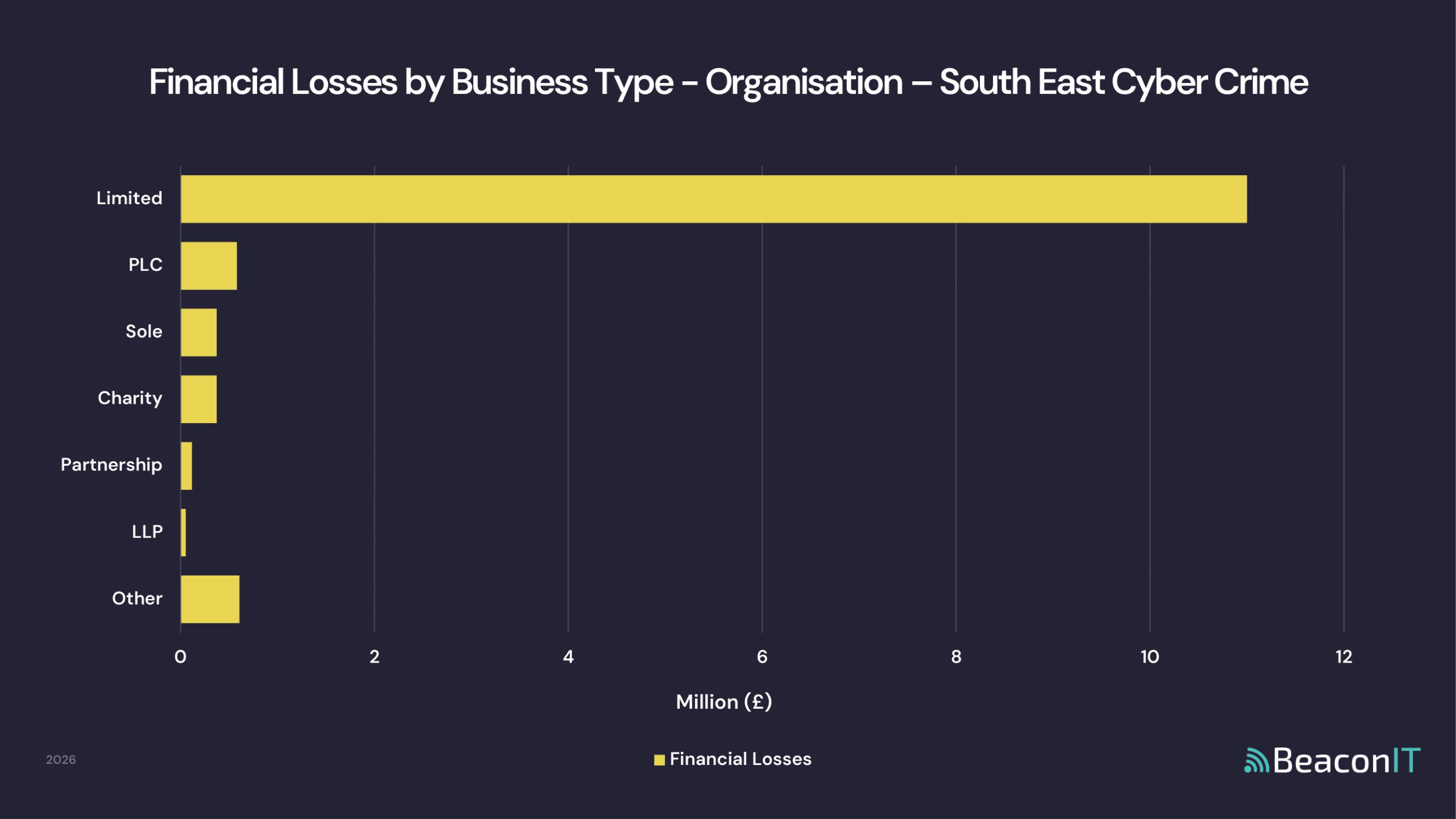
| Business Type | Losses | % | Loss/Report |
| Limited | £11m | 81.5% | £9.8k |
| PLC | £582.2k | 4.3% | £6.8k |
| Sole | £373.9k | 2.8% | £6.4k |
| Charity | £373.6k | 2.8% | £6.3k |
| Partnership | £117.7k | 0.9% | £8.4k |
| LLP | £54k | 0.4% | £6k |
| Other | £608.3k | 4.5% | £7.1k |
Insights for Organisational Financial Losses via Business Types
- Limited companies suffer the overwhelming majority of financial losses – Limited businesses account for 81.5% of total losses (£11m), with an average loss of £9.8k per incident.
- ‘Other’ business structures represent a disproportionate share of losses – Although smaller in volume, they account for £608.3k in losses (4.5%), with an average loss of £7.1k per report.
- PLCs experience relatively low overall losses – Publicly listed companies account for 4.3% of losses (£582.2k), with an average loss of £6.8k per incident.
- Small businesses face meaningful financial exposure – Sole traders and partnerships together account for £491.6k in losses, with average losses between £6.4k and £8.4k per incident.
- Charities experience similar financial impact to sole traders – Charitable organisations account for £373.6k in losses (2.8%), with an average loss of £6.3k per incident.
About The Data - South East UK Cyber Crime Statistics
Based on a rolling 12 months of data from Report Fraud.
Data is provided by the following police forces: Hampshire, Surrey, Sussex, and Thames Valley.
The South East UK cyber crime statistics data is extracted from the NFIB Fraud and Cyber Crime dashboard between 01/01/2025 and 31/12/2025.
Only 'cyber-enabled' fraud and cyber crime offences amounting to a crime under the Home Office Crime Recording rules are included.
Cyber-enabled crimes are traditional crimes, which can be increased in their scale or reach by use of computers, computer networks or other forms of IT.
Information reports and crimes reported directly from partner agencies and industry are not included at this time and will account for differences to Office for National Statistics figures for fraud offences in the same period.
For more information relating to different types of fraud and cyber crime please see the A-Z of fraud section on the Report Fraud website.
Limitations
South East UK cyber crime statistics data is based on victim selection during the reporting process and this has not been verified.
Losses are based on loss amounts as reported in Report Fraud recorded crimes and these have not been verified. Where possible, efforts have been made to review losses reported in excess of £500k but further investigation may be required to determine if loss amounts are a true reflection of the financial impact of the reported crime.
Extreme outliers have been removed to limit data skew.
Crime Types
See crime type definitions in the main cyber crime stats article.
Regional Breakdown
Below is a list of regions that our cyber crime research is broken down into:
- London
- South East
- South West
- North West
- North East
- East
- East Midlands
- West Midlands
- Yorkshire & Humber
- Scotland
- Wales
- Northern Ireland
Further Reading
For more information about South East UK cyber crime statistics, take a look at the following sources: