


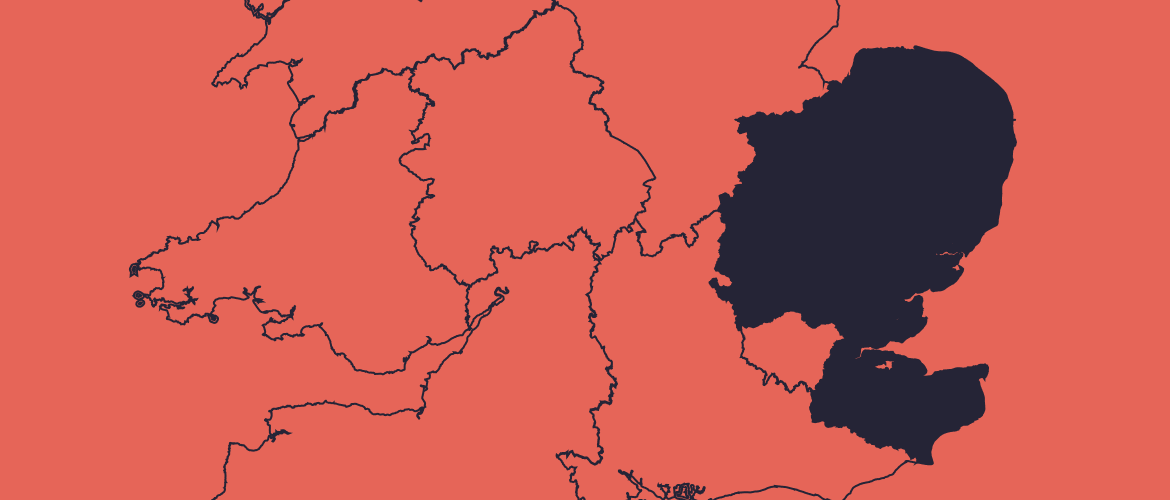
This breakdown of East of England cyber crime statistics goes beyond the raw numbers. It looks at why everyday behaviour, from how people work to how businesses operate, is creating opportunity for attackers, and what makes this region particularly attractive compared to others.
Because cyber crime rarely starts with sophisticated technology.
It usually starts with habits.
In the 12 months leading up to 1 January 2026 in the East of England, there have been:

East of England Cyber Crime Key Insights
- Everyday scams dominate volume, but not value - Consumer crime accounts for 38.9% of reports (11.3k), yet investment fraud drives 48% of total losses (£52.8m), showing that fewer incidents are causing far greater financial harm in the East of England.
- Cyber crime in the region is largely behavioural, not technical - Advance fee and consumer fraud together make up 57.3% of all reports, reinforcing that social engineering remains more effective than malware.
- Cyber dependent crime is widespread but usually contained - It represents 24.2% of reports (7.1k), yet only 1.1% of losses (£1.2m), suggesting incidents are frequent but often detected before major financial damage occurs.
- Banking fraud is less common, but immediately disruptive - At 10.5% of reports, banking fraud still accounts for £14.3m in losses, reflecting its direct impact on cash flow rather than slow financial erosion.
- Low public sector and corporate figures reflect reporting behaviour, not risk - Together they account for just 1% of reports, despite operating critical systems and large budgets, indicating delayed or alternative reporting routes.
Individuals
- Working-age adults face the highest exposure - People aged 30–49 account for 37% of individual reports, driven by heavy use of email, online banking, and digital services.
- Financial impact peaks later than report volume - Individuals aged 50–69 account for over 41% of total losses (£39.7m), despite fewer reports than younger groups.
- Investment fraud is the most damaging threat to individuals - It represents just 7.6% of reports, but causes 52.1% of individual losses (£49.7m) in the East of England, with an average loss of £23.5k per report.
- Consumer fraud causes steady financial drain - Consumer scams generate 38.8% of reports and £27.9m in losses, showing how repeated lower-value fraud accumulates over time.
- Cyber dependent incidents are common but low value - While 24.6% of individual reports, average losses sit at just £123 per report, pointing to disruption rather than financial devastation.
Organisations
- Limited companies bear the brunt of regional cyber crime - They account for 65.3% of organisational reports and 70.5% of total losses (£10.2m), reflecting the SME-heavy make-up of the East of England.
- Banking fraud is the biggest organisational financial threat - It represents 39% of reports but drives 45.6% of losses (£6.6m), highlighting invoice fraud and payment diversion risk.
- Investment fraud is rare but severe for organisations - Just 2.8% of reports, yet 21.4% of losses, with the highest loss per report (£77.5k) of any category.
- Consumer-facing fraud is hitting businesses hard - Consumer-related incidents generate 40.2% of reports and £4.3m in losses, driven by chargebacks, refunds, and impersonation scams.
- Smaller business types face outsized impact per incident - LLPs and “Other” organisations show losses per report above £10k, despite low volumes, indicating targeted, high-value attacks.
East of England Cyber Crime Statistics Breakdown
Crime Types
By report volume

| Crime Type | Reports | % |
| Advance Fee | 5.4k | 18.4% |
| Banking | 3.1k | 10.5% |
| Consumer | 11.3k | 38.9% |
| Corporate | 183 | 0.6% |
| Cyber Dependent | 7.1k | 24.2% |
| Investment | 2.2k | 7.4% |
| Public Sector | 9 | 0.0% |
Insights for Report Volume
- Consumer fraud leads because the region is highly digital - Nearly 40% of reports are consumer-related. High levels of online banking, remote work, and digital services across the East of England have increased everyday exposure to scams. This reflects widespread digital use, not a lack of awareness.
- Cyber dependent crime shows cloud adoption has outpaced security - At 24.2% of reports, cyber dependent crime mirrors rapid SME uptake of cloud tools and remote access. Security controls and user training have not always kept pace with this shift.
- Advance fee fraud exploits trust and urgency - Advance fee scams account for 18.4% of reports, driven by time-sensitive transactions common in property, education, and professional services. Social engineering continues to outperform technical attacks in the region.
- Banking fraud is lower in volume but high in disruption - Although 10.5% of reports, banking fraud often causes immediate cash flow and operational impact for East of England households and SMEs operating with tight margins.
- Low corporate and public sector reporting masks risk - Corporate and public sector reports are minimal, but this likely reflects delayed reporting or internal handling. Lower volume should not be mistaken for lower exposure.
By financial losses

| Crime Type | Losses | % | Loss/Report |
| Advance Fee | £9m | 8.2% | £1.7k |
| Banking | £14.3m | 13.0% | £4.7k |
| Consumer | £32.2m | 29.3% | £2.8k |
| Corporate | £0.4m | 0.3% | £2.1k |
| Cyber Dependent | £1.2m | 1.1% | £167 |
| Investment | £52.8m | 48.0% | £24.5k |
| Public Sector | £64.8k | 0.1% | £7.2k |
Insights for Financial Losses
- Investment fraud drives nearly half of all financial losses - Investment scams account for 48% of total losses in the East of England, despite relatively modest report volumes. This reflects higher-value targets, longer scam durations, and increased exposure to sophisticated, well-disguised investment opportunities.
- Consumer fraud is high-volume and materially costly - Consumer crime represents 29.3% of losses, showing that everyday scams are not low-impact. In a region with widespread digital banking and online purchasing, repeated smaller losses are adding up quickly.
- Banking fraud hits harder per incident - Banking fraud makes up 13% of losses, with a higher loss per report than consumer crime. For East of England households and SMEs, these incidents often lead to immediate disruption rather than gradual financial erosion.
- Cyber dependent crime is frequent but financially contained - Although cyber dependent incidents are common, they account for just 1.1% of losses, with a low loss per report. This suggests early detection, recovery, or containment, but still highlights operational risk and recovery costs beyond direct financial loss.
- Low corporate and public sector losses mask wider impact - Corporate and public sector losses appear small, but this likely reflects incident handling outside formal reporting. In the East of England, reputational damage and service disruption may outweigh reported financial figures.
East of England Cyber Crime Statistics for Individuals

Crime Types
By report volume

| Crime Type | Reports | % |
| Advance Fee | 5.4k | 19.3% |
| Banking | 2.5k | 9.1% |
| Consumer | 10.8k | 38.8% |
| Corporate | 172 | 0.6% |
| Cyber Dependent | 6.8k | 24.6% |
| Investment | 2.1k | 7.6% |
| Public Sector | 4 | 0.0% |
Insights for Individual Report Volume
- Consumer fraud dominates everyday cyber crime for individuals - At 38.8% of reports, consumer fraud is the most common issue faced by individuals. Online shopping, digital subscriptions, and marketplace activity have increased exposure to low-effort, high-frequency scams across the region.
- Cyber dependent crime reflects reliance on personal devices and home networks - With 24.6% of reports, cyber dependent crime shows how much daily life depends on personal laptops, phones, and home Wi-Fi. Weak passwords, delayed updates, and shared devices continue to create easy entry points.
- Advance fee scams thrive on trust and urgency - Advance fee fraud makes up 19.3% of individual reports, often linked to rental deposits, delivery charges, or “too good to miss” offers. These tactics remain effective in a region with high levels of private renting and online transactions.
- Banking fraud is less frequent but highly disruptive - Although 9.1% of reports, banking fraud frequently results in immediate financial stress for individuals, particularly where savings and day-to-day accounts are closely linked.
- Investment fraud affects fewer individuals but carries serious consequences - At 7.6% of reports, investment scams are lower in volume but often involve larger sums and longer-term manipulation, with growing use of social media and impersonation tactics targeting individuals across the East of England.
By financial losses

| Crime Type | Losses | % | Loss/Report |
| Advance Fee | £8.9m | 9.3% | £1.7k |
| Banking | £7.7m | 8.1% | £3.1k |
| Consumer | £27.9m | 29.2% | £2.6k |
| Corporate | £0.4m | 0.4% | £2.1k |
| Cyber Dependent | £0.8m | 0.9% | £123 |
| Investment | £49.7m | 52.1% | £23.5k |
| Public Sector | £47.4k | 0.0% | £11.9k |
Insights for Individual Financial Losses
- Investment fraud is the clear financial outlier for individuals - Investment scams account for 52.1% of all individual losses, despite relatively low report volumes. This reflects fewer victims, but far higher-value losses, often driven by long-running scams and persuasive impersonation tactics.
- Consumer fraud creates steady, cumulative financial damage - Consumer crime makes up 29.2% of losses, showing how frequent, lower-value scams are quietly adding up. Regular online purchasing and digital subscriptions across the region have increased exposure to repeat losses.
- Banking fraud hits personal finances hard and fast - Although responsible for 8.1% of losses, banking fraud often causes immediate disruption to individuals’ day-to-day finances, particularly where wages, savings, and bills are tied closely together.
- Advance fee scams remain financially significant for individuals - Advance fee fraud represents 9.3% of losses, often linked to rentals, deliveries, or upfront fees. These scams continue to thrive in a region with high private renting and online marketplaces.
- Cyber dependent crime is common but usually contained financially - Cyber dependent incidents account for less than 1% of losses, with very low loss per report. This suggests early detection or limited financial exposure, even though the disruption and recovery effort can still be considerable.
Age Demographics
By report volume

| Age | Reports | % |
| Age (0-9) | 68 | 0.2% |
| Age (10-19) | 899 | 3.2% |
| Age (20-29) | 4k | 14.5% |
| Age (30-39) | 5.3k | 19.0% |
| Age (40-49) | 5k | 18.0% |
| Age (50-59) | 4.3k | 15.5% |
| Age (60-69) | 3.5k | 12.8% |
| Age (70-79) | 3k | 10.6% |
| Age (80-89) | 1.3k | 4.7% |
| Age (90-99) | 134 | 0.5% |
| Age (100+) | 4 | 0.0% |
Insights for Report Volume via Age Demographics
- Cyber crime peaks in working-age adults - Individuals aged 30–49 account for 37% of reports, making this the most affected group. This reflects high daily exposure to email, online banking, work platforms, and digital services, rather than a lack of awareness.
- Younger adults are heavily exposed through digital lifestyles - Those aged 20–29 contribute 14.5% of reports, driven by frequent use of online marketplaces, subscriptions, social platforms, and mobile-first banking. Convenience and speed remain key risk factors.
- Risk remains high well into later working life - People aged 50–69 make up 28.3% of reports, showing that cyber crime does not taper off with age. Continued digital engagement in work, finance, and personal admin keeps exposure high.
- Older age groups still face meaningful risk - Individuals aged 70–79 account for 10.6% of reports, underlining that cyber crime is not confined to younger users. Scams targeting trust, authority, and urgency remain effective across this group.
- Very low reporting at the extremes reflects usage, not immunity - Minimal reports from the youngest and oldest age groups largely reflect lower independent digital activity rather than reduced threat. Where exposure exists, risk remains.
By financial losses

| Age | Losses | % | Loss/Report |
| Age (0-9) | £38k | 0.0% | £559 |
| Age (10-19) | £460k | 0.5% | £512 |
| Age (20-29) | £7.1m | 7.4% | £1.8k |
| Age (30-39) | £9.3m | 9.7% | £1.8k |
| Age (40-49) | £18.1m | 19.0% | £3.6k |
| Age (50-59) | £19.7m | 20.6% | £4.6k |
| Age (60-69) | £20m | 21.0% | £5.6k |
| Age (70-79) | £15.1m | 15.8% | £5.1k |
| Age (80-89) | £4.9m | 5.1% | £3.7k |
| Age (90-99) | £245.5k | 0.3% | £1.8k |
| Age (100+) | £4k | 0.0% | £1k |
Insights for Financial Losses via Age Demographics
- Financial losses peak later than report volumes - While reports are highest among those aged 30–49, the largest financial losses sit with 50–69 year olds, who account for over 40% of total losses. Fewer incidents, but far higher value.
- The highest losses concentrate where assets are greatest - Individuals aged 60–69 record the highest total losses (£20m) and the highest loss per report (£5.6k). This reflects greater access to savings, pensions, and investment products targeted by scammers.
- Working-age adults face frequent losses, but at lower value - Those aged 30–39 and 40–49 experience high report volumes and rising losses, but lower loss per report than older groups. This suggests repeated, lower-value scams rather than single catastrophic incidents.
- Loss severity increases with age - Loss per report rises steadily from younger adults through to those in their 60s and 70s, indicating that scams become more financially damaging as individuals’ available funds and trust-based decision-making increase.
- Very young and very old groups show low financial impact due to exposure, not safety - Minimal losses among the youngest and oldest age groups largely reflect reduced independent digital and financial activity. Where exposure exists, risk remains present rather than absent.
East of England Cyber Crime Statistics for Organisations

Crime Types
By report volume

| Crime Type | Reports | % |
| Advance Fee | 3 | 0.2% |
| Banking | 549 | 39.0% |
| Consumer | 566 | 40.2% |
| Corporate | 11 | 0.8% |
| Cyber Dependent | 234 | 16.6% |
| Investment | 40 | 2.8% |
| Public Sector | 5 | 0.4% |
Insights for Organisational Report Volume
- Organisational cyber crime is dominated by consumer and banking fraud - Consumer (40.2%) and banking fraud (39.0%) account for nearly four-fifths of organisational reports. This reflects how businesses are increasingly targeted through payment processes, refunds, chargebacks, and customer-facing systems rather than purely internal IT failures.
- Banking fraud is the primary organisational pressure point - With 549 reports, banking fraud represents the most consistent threat to organisations in the region. Invoice manipulation, payment diversion, and account compromise continue to affect day-to-day cash flow for East of England businesses.
- Cyber dependent crime highlights exposure, not collapse - At 16.6% of reports, cyber dependent incidents show that organisations are encountering malware, unauthorised access, and system misuse, but not yet at volumes suggesting widespread operational failure. Detection appears to be improving, even if prevention lags.
- Investment and advance fee fraud are present but limited in volume - Investment (2.8%) and advance fee fraud (0.2%) are far less common for organisations than individuals. Where they do occur, they are typically tied to senior decision-makers or one-off high-value transactions rather than broad staff exposure.
- Low corporate and public sector reporting likely reflects handling, not immunity - Minimal reports from corporate and public sector bodies suggest incidents are often managed internally, through insurers, or via specialist response channels. In the East of England, this likely masks underlying exposure rather than indicating low risk.
By financial losses

| Crime Type | Losses | % | Loss/Report |
| Advance Fee | £91.8k | 0.6% | £30.6k |
| Banking | £6.6m | 45.6% | £12k |
| Consumer | £4.3m | 29.7% | £7.6k |
| Corporate | £9.5k | 0.1% | £864 |
| Cyber Dependent | £339.6k | 2.3% | £1.5k |
| Investment | £3.1m | 21.4% | £77.5k |
| Public Sector | £17.4k | 0.1% | £3.5k |
Insights for Organisational Financial Losses
- Banking fraud is the single biggest financial threat to organisations - Banking fraud accounts for 45.6% of total losses (£6.6m), making it the most damaging crime type for organisations in the region. Payment diversion, invoice fraud, and compromised accounts continue to hit cash flow directly.
- Consumer-related incidents create significant business losses - Although often seen as lower risk, consumer fraud drives 29.7% of organisational losses (£4.3m). Refund abuse, chargebacks, and customer-facing scams are creating real financial exposure for East of England businesses.
- Investment fraud is rare but extremely costly per incident - Investment fraud represents 21.4% of losses, with the highest loss per report (£77.5k). These incidents are infrequent but typically involve senior decision-makers and high-value transactions.
- Cyber dependent crime causes disruption more than direct loss - Cyber dependent incidents make up 2.3% of losses, with relatively low financial impact per report. However, these figures do not capture downtime, recovery costs, or reputational damage, which are often more severe.
- Low corporate and public sector losses mask wider risk - Minimal reported losses in corporate and public sector categories likely reflect alternative handling routes such as insurers or internal response teams. In the East of England, financial reporting alone understates organisational exposure.
Business Types
By report volume

| Business Type | Reports | % |
| Limited | 919 | 65.3% |
| PLC | 179 | 12.7% |
| Sole | 82 | 5.8% |
| Charity | 52 | 3.7% |
| Partnership | 17 | 1.2% |
| LLP | 3 | 0.2% |
| Other | 74 | 5.3% |
Insights for Organisational Report Volume via Business Types
- Limited companies dominate organisational cyber crime reports - Limited companies account for 65.3% of reports, reflecting the make-up of the East of England business landscape. Most cyber crime exposure sits with SMEs operating as limited entities rather than large corporates.
- PLCs face notable exposure despite lower numbers - PLCs represent 12.7% of reports, a significant share given their smaller presence locally. This suggests higher reporting maturity and greater visibility of incidents rather than disproportionate targeting.
- Sole traders and small partnerships remain exposed but under-represented - Sole traders, partnerships, and LLPs account for a relatively small proportion of reports. This likely reflects under-reporting, limited detection capability, or informal handling rather than reduced risk.
- Charities continue to face consistent cyber pressure - Charities make up 3.7% of reports, highlighting ongoing targeting of organisations with limited budgets, volunteer-heavy operations, and often weaker security controls.
- “Other” business types point to a long tail of exposure - The 5.3% classified as “Other” shows cyber crime affecting a broad mix of organisations beyond traditional structures, reinforcing that risk is widespread across the regional economy.
By financial losses

| Business Type | Losses | % | Loss/Report |
| Limited | £10.2m | 70.5% | £11.1k |
| PLC | £2.6m | 18.0% | £14.5k |
| Sole | £401k | 2.8% | £4.9k |
| Charity | £294.3k | 2.0% | £5.7k |
| Partnership | £12k | 0.1% | £706 |
| LLP | £32.8k | 0.2% | £10.9k |
| Other | £761.2k | 5.3% | £10.3k |
Insights for Organisational Financial Losses via Business Types
- Limited companies carry the bulk of financial impact - Limited companies account for 70.5% of total losses (£10.2m), reflecting both their dominance in the regional economy and their exposure to payment fraud, invoicing scams, and customer-facing risk.
- PLCs suffer higher losses per incident - Although responsible for 18% of losses, PLCs record a higher loss per report (£14.5k) than limited companies. Fewer incidents, but more complex systems and higher-value transactions amplify impact when things go wrong.
- Smaller organisations face proportionally serious losses - Sole traders and charities represent a small share of total losses, but loss per report remains material. For smaller organisations in the East of England, even modest financial hits can be operationally significant.
- LLPs and “Other” organisations show high loss severity - Despite low report volumes, LLPs and “Other” business types have high loss per report, indicating targeted, high-value incidents rather than opportunistic attacks.
- Partnerships show low reported losses, not low risk - Partnerships account for minimal financial loss, but this likely reflects under-reporting or informal resolution rather than genuine immunity. Exposure still exists where financial controls are shared or loosely defined.
About The Data - East of England Cyber Crime Statistics
Based on a rolling 12 months of data from Report Fraud.
Data is provided by the following police forces: Bedfordshire, Cambridgeshire, Essex, Hertfordshire, Kent, Norfolk, and Suffolk.
The East of England cyber crime statistics data is extracted from the NFIB Fraud and Cyber Crime dashboard between 01/01/2025 and 31/12/2025.
Only 'cyber-enabled' fraud and cyber crime offences amounting to a crime under the Home Office Crime Recording rules are included.
Cyber-enabled crimes are traditional crimes, which can be increased in their scale or reach by use of computers, computer networks or other forms of IT.
Information reports and crimes reported directly from partner agencies and industry are not included at this time and will account for differences to Office for National Statistics figures for fraud offences in the same period.
For more information relating to different types of fraud and cyber crime please see the A-Z of fraud section on the Report Fraud website.
Limitations
East of England cyber crime statistics data is based on victim selection during the reporting process and this has not been verified.
Losses are based on loss amounts as reported in Report Fraud recorded crimes and these have not been verified. Where possible, efforts have been made to review losses reported in excess of £500k but further investigation may be required to determine if loss amounts are a true reflection of the financial impact of the reported crime.
Extreme outliers have been removed to limit data skew.
Crime Types
See crime type definitions in the main cyber crime stats article.
Regional Breakdown
Below is a list of regions that our cyber crime research is broken down into:
- London
- South East
- South West
- North West
- North East
- East
- East Midlands
- West Midlands
- Yorkshire & Humber
- Scotland
- Wales
- Northern Ireland
Further Reading
For more information about East of England cyber crime statistics, take a look at the following sources: